Fewer niggles. Easier miles. A stride that makes sense.
Six runner types. Six different form faults. Six different fixes. Every runner has a pattern — and yours has a name.
Find my runner type →Free quiz · 2 minutes · No signup needed
“I ran for years with a pattern nobody ever pointed out. That's why this exists.” Ryan · Run Right
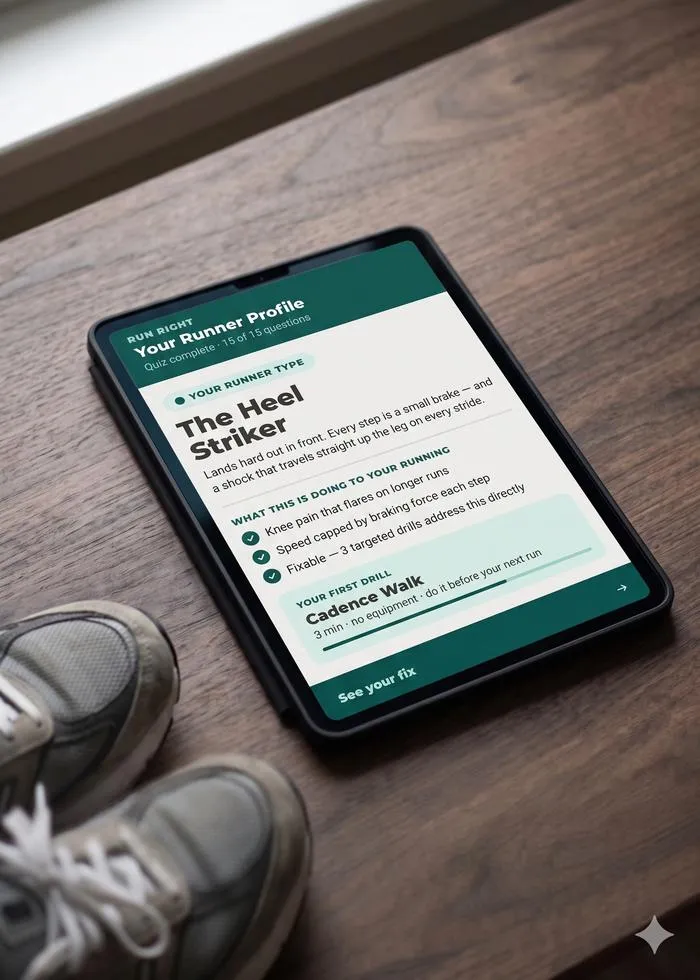
You have been running the same way for years. Nobody has ever watched you do it and told you what they saw.
So the niggle keeps coming back, the same route never gets easier, and you put it down to age, or mileage, or shoes.
It is almost never any of those. It is one movement, repeated a thousand times a run.
Every recreational runner has one of six signatures. Each has its own biggest opportunity — and most people are surprised by theirs. Each type and its drills are grounded in published biomechanics research.
Smooth, economical, low and steady. A little more turnover turns your easy stride into free speed.
Long, ground-covering stride. Bring the landing under your hips and you stop braking yourself every step.
Real spring and power. Aim it forward instead of up and all that power becomes pace.
Energetic, driving arms. Stop them crossing your body and one side stops doing the other's work.
Forward-driving, committed. Lean tall from the ankles and your glutes finally switch on — more drive, less back.
Nothing is broken. There is still a few percent on the table, and you are the one who will go and get it.
Not a sample. Not a teaser chapter. Everything, built around whichever of the six you turn out to be.
Getting someone to watch you run and tell you what they see is not usually cheap. Here is the going rate in the UK.
A good coach is worth every penny, and if you are injured, see a physio first. This is for the runner who was never going to book either.
Real reviews from runners who tested the programme.
“Knee pain gone by week two. Eight years of running and nobody told me I was braking with every step. Three drills changed everything.”
“Dropped 18 seconds per km without training harder. The bounce was burning energy I didn't know I was wasting.”
“Shin splints haven't come back since week four. Wish I'd known about this years ago.”
“Coming back to running at 50 felt like starting over. I knew I needed to get my form right to stay injury-free. It's helped so much.”
“Same route, less effort. Feels like someone gave me better legs.”
“Doing triathlons in my 50s. Running is where I make up the most time — and fixing my pattern means I'm doing better than my 30-year-old self.”
There isn't one, but it is a fair question, so here is the honest answer.
Reading isn't the hard part. Doing it is. We don't charge for the information because most of it is findable if you look hard enough — and because a PDF has never made anyone finish anything. You have probably got one on your phone right now that you stopped opening in week two.
What we charge for is the part that is actually hard: someone checking in every few days, telling you which drill is next, and moving the plan when you miss a week. That is optional, and you will not be asked about it until you have had the free library for a while.
The goal is a million runners running correctly. Charging them to find out how was never going to get us there.
Week eight is the part almost nobody reaches. Not because the drills are hard — because week two is dull, in week three you miss one, and by week four you have lost your place.
The Finish Line is a check-in every three days for those eight weeks. It tells you which drill is next, and when you miss a week it moves the plan to where you actually are. It comes with 34 more drills for hills, breathing and recovery. £49, once, with a 30-day refund.
You will find it inside the library when you are ready. There is nothing to buy today, and the free library stays free either way.
Photograph the soles of your running shoes and our free scanner reads the wear pattern. Same six types, no quiz.
Try Sole Scan — free →Yes. Everything above, permanently, with no card and no trial. We ask for your email so we can send the printable version, and you can skip that and go straight in.
About two minutes. Six questions about how you run and what bothers you. You get your result immediately.
Especially. Most of the runners this helps are recreational, often coming back after a break, usually dealing with a niggle that keeps returning. You do not need to be fast for your form to be costing you.
Yes. The quiz meets you wherever you are. Most recreational runners have never had formal technique instruction, regardless of how long they have been running. The drills scale to your level.
The shoes you already run in, a wall, and about 20 metres of flat ground. A free metronome app helps for the cadence drills.
These are technique drills, not treatment. If you are currently injured or in pain, see a physiotherapist first — the library will still be here.
Two minutes. Six questions. Then all of it, free.
Find my runner type →No card · no trial · yours to keep